


Different Types of Couplings and Their Benefits
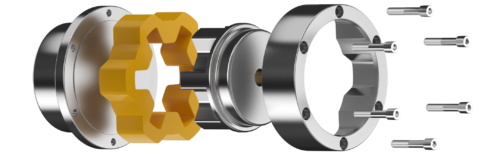
Couplings can significantly influence machine longevity and downtime despite the fact that they often get overlooked. In industrial applications, external factors like misalignment and vibration are almost impossible to avoid. The correct coupling can mitigate these effects, helping minimize maintenance and premature wear.
That’s why selecting a coupling type is more than a design choice; it’s a safeguard for long-term system reliability. At U.S. Tsubaki, our Atra-Flex® couplings are engineered to meet these demands in industries ranging from food and beverage to primary metals.
This guide breaks down the different types of couplings, how they work, and where they excel, along with common missteps to avoid when selecting one for your application.
What Is a Flexible Coupling?
A flexible coupling is a mechanical device connecting two shafts to transmit power, usually from a motor or gearbox to the equipment it drives. It forms a continuous path for torque, protects connected equipment from torque overloads, and accommodates for misalignment. Flexible couplings are designed to handle angular, parallel, and axial misalignment while dampening vibration and absorbing torsional shock.
Flexible couplings help reduce stress on connected equipment and accommodate dynamic conditions such as thermal growth or shaft deflection.
Ideal for high-speed shafts and systems subject to misalignment or impact loads, these couplings are widely used in industrial drives. For example, Atra-Flex® T-Series offers high torque capacity with minimal maintenance, while the M-Series excels in shock absorption and durability in applications were fast insert replacements are desired.
Common Types of Flexible Couplings
Shaft alignment will change overtime due to various application conditions. Thermal expansion, shock loads, vibration, and mounting variations all introduce movement and stress across rotating components.
Flexible couplings are designed to manage these variables while transmitting torque efficiently and protecting connected equipment. However, different coupling designs manage these demands differently, whether by flexing, compressing, or sliding between components.
The key is choosing a flexible coupling that matches your system’s behavior under load.
Elastomeric Couplings
Elastomeric couplings use a flexible element (typically rubber or polyurethane) to transmit torque and accommodate misalignment. Most elastomeric couplings are designed with replaceable inserts.
Common types include:
- Jaw couplings, which use a star-shaped elastomer known as a spider in compression between interlocking hubs
- Tire couplings, which transmit torque through a rubber tire-shaped element in shear
- Pin and bushing couplings, which rely on metal pins and rubber bushings to transmit torque
- Wrap style coupling, which uses a replace-in-place elastomeric element that wraps around hubs. Atra-Flex® offers this style known as T-Flex® and Millennium®
These designs are valued for their low noise, torsional damping, and ease of installation. They also reduce transmitted vibration, helping extend the life of connected components.
Metallic Couplings
Engineered for strength, metallic couplings are often chosen in legacy applications. Depending on the design, they can accommodate limited misalignment while maintaining high torque capacity.
Some of the most widely used metallic couplings include:
- Gear couplings for high torque with slight misalignment tolerance requiring lubrication
- Grid couplings for shock load absorption via a spring-like grid element requiring lubrication
- Disc couplings for torsionally stiff, zero-backlash operation in high-speed applications
Beam (Helical) Couplings
Machined from a single piece of metal with spiral cuts, beam couplings flex under load while maintaining a continuous path for torque.
They’re best suited for low-torque, precision applications like servo motors, robotics, and lab automation, where zero backlash and compact size are essential.
Universal Joint (U-Joint Couplings)
U-joint couplings are designed to transmit torque between shafts that operate at variable or fixed angles. Their cross-pin assembly allows continuous rotation even when alignment shifts during operation.
This makes them especially useful in applications with unavoidable angular misalignment, like mobile conveyors and rolling mill drives. While not constant velocity devices, U-joints offer a rugged, compact solution for systems that demand flexibility under load.
Fluid Couplings
Fluid couplings transmit torque between the input and output sides using hydraulic fluid rather than direct contact. This allows for smooth acceleration under load, making them ideal for soft-start applications where sudden torque spikes could damage connected equipment.
Commonly used in bulk material handling systems like crushers and belt conveyors, fluid couplings also provide inherent overload protection by slipping under excessive load.
Special Couplings
Advanced coupling designs address niche needs such as corrosion resistance, fail-safe operation, or extreme temperature tolerance.
For example, Atra-Flex® OnyxShield™ delivers added protection in caustic or washdown environments. Other specialized couplings include magnetic designs for seal-less torque transfer and torque-limiting models for overload protection in sensitive equipment.
Coupling Selection by Application
Every industrial system places distinct demands on its coupling. Matching the right type to the application ensures smoother performance and long-term reliability:
- Centrifugal pumps benefit from flexible elastomeric couplings. These couplings dampen vibration and handle shaft misalignment without transmitting excessive stress.
- Positive displacement pumps or compressors, which generate pulsating torque, are better suited for elastomeric or grid couplings that provide torsional stiffness and absorb shock.
- Conveyor systems, especially those in aggregate or material handling, often experience shaft movement and load variability. The Atra-Flex® M-Series offers ideal misalignment tolerance and impact absorption for these conditions.
- High-speed drives, such as those in printing or automation systems, require precise motion transfer. Disc or beam couplings, with their zero-backlash characteristics and torsional rigidity, are well-suited for these tasks.
It’s also important not to overlook the environment in which your equipment operates. Washdowns in food processing, abrasive dust in cement plants, and outdoor temperature swings can impact coupling performance.
In some cases, the wrong material choice can lead to early failure, even if the torque specs are correct.
Factors To Consider When Choosing a Coupling
Selecting the right coupling involves finding the best-fit solution to support uptime and extend system life.
Before finalizing your choice, it’s worth evaluating a few key factors:
- Torque and Speed: Know your system’s peak and continuous torque, as well as operating RPM. Undersizing can lead to premature failure.
- Misalignment Type: Determine the degree of angular, parallel, and axial misalignment that the coupling must accommodate.
- Maintenance Requirements: If regular lubrication or part replacement isn’t feasible, prioritize minimal maintenance designs with replaceable elastomeric inserts or non-lubricated flex elements.
- Operating Environment: Exposure to moisture, washdowns, chemicals, or abrasive dust should influence material and design choices. Atra-Flex® OnyxShield™ could be a good fit for these applications.
For guidance tailored to your specific application, try our Coupling Selection Tool and compare your options. If you prefer to get advice from an expert, you can also connect with us for inquiries.
Advantages of the Right Coupling Type
When a coupling matches the system’s load, alignment, and environmental demands, the benefits go beyond basic functionality.
The right choice reduces component fatigue, lowers energy losses, and supports consistent performance across variable conditions. It also minimizes unplanned maintenance by managing vibration, compensating for shaft movement, and preventing misalignment-related wear.
Atra-Flex® couplings are engineered with these advantages in mind. From the torque-dense, minimal maintenance T-Series to the shock-absorbing M-Series, each is designed to deliver long-term reliability with minimal system disruption.
FAQs About Coupling Types
What are the two main types of couplings?
Couplings fall into two broad categories: rigid and flexible. Rigid couplings maintain a fixed connection between shafts and are used in applications where precise alignment is possible. On the other hand, flexible couplings accommodate misalignment and help isolate vibration or shock loads.
Which coupling type is best for misalignment?
Flexible couplings are best suited for managing misalignment. Designs like elastomeric, or universal joint (U-joint) couplings absorb movement while maintaining reliable torque transfer.
What are flexible coupling examples?
Common flexible couplings include elastomeric, pin-bush, disc, grid, gear, and fluid couplings. Each type is optimized for different conditions, such as vibration damping, torque capacity, or precision motion control.
Find the Right Atra-Flex Coupling for Your Application
Coupling choice should never be an afterthought. It directly affects uptime, equipment longevity, and overall system efficiency. Because no two applications are exactly alike, matching the coupling to your system’s specific requirements is essential.
Atra-Flex® couplings are engineered to meet the performance demands of modern industry, from high torque to resistance to harsh environments. Whatever your application, there’s a solution built for it:
- T-Series: Delivers torque-dense, minimal maintenance performance for continuous-duty systems
- M-Series: Absorbs shock and handles misalignment in rugged, high-impact environments requiring no special tools or fasteners for insert replacement
- OnyxShield™: Provides enhanced corrosion resistance in caustic, sanitary, or chemical environments
Don’t settle for a generic fit. Get a coupling engineered for your environment. Feel free to ask our experts to find the right solution for your system. Already found the perfect fit? Request a quote today.
**Use this for request a quote links for ATR couplings: Request a Quote – ATRA-FLEX****
Comments are closed