


The Hidden Cost of Low-Cost Roller Chain
Looking Beyond Purchase Price to Life-Cycle Cost
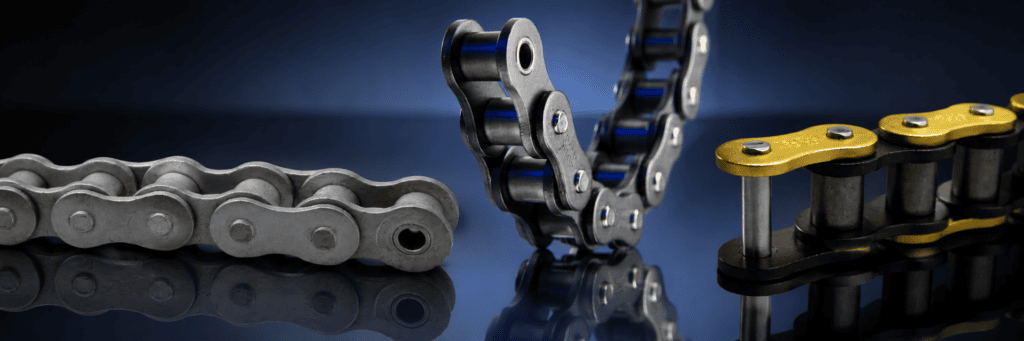
Many maintenance and reliability teams face a familiar decision: selecting between two roller chains that share the same ANSI size and appear suitable for the same application, yet differ significantly in price. ANSI size establishes key dimensional requirements, but it does not define every characteristic that can affect performance in an application. Materials, heat treatment, bearing-surface geometry, lubrication, and other design details can influence factors such as allowable loading and wear life.
While the lower-priced option may appear to offer the best value, purchase price represents only one part of a chain drive’s total cost. Service life, maintenance requirements, downtime, lubrication, sprocket wear, and replacement frequency can all contribute to life-cycle cost.
In many operations, even a relatively short unplanned shutdown or emergency maintenance event can add costs associated with labor, lost production, and replacement components that outweigh the initial savings from a lower-priced chain. When labor, lost production, and replacement components are considered, the initial price difference can become a relatively small part of the overall cost.
Why Chain Wear Matters
Understanding life-cycle cost starts with understanding how roller chain wears. During normal service, roller chain elongation primarily results from wear between the pins and bushings rather than physical stretching of the chain components. As these surfaces wear, the chain’s effective pitch increases and engagement with the sprocket gradually deteriorates.
Chain elongation should be measured as part of routine inspection. As a general guideline, Tsubaki considers approximately 1.5% wear elongation a typical wear-life limit for drive applications with 60 or fewer teeth on the driving sprocket; larger sprockets have lower limits. As elongation increases, the chain begins to ride higher on the sprocket teeth, which can contribute to accelerated chain and sprocket wear. Tsubaki’s Installation & Maintenance Guide provides additional guidance on chain wear, lubrication, inspection, and replacement.
Premature chain wear can lead to:
- More frequent tension adjustments
- Increased vibration
- Accelerated sprocket wear
- More frequent chain replacement
- Unplanned downtime
How quickly this occurs depends on the application. Load, speed, lubrication, contamination, corrosion, alignment, shock loading, and maintenance practices can all influence chain life. That’s why two chains of the same ANSI size may perform differently under the same operating conditions.
Match the Chain to the Operating Environment
The goal isn’t necessarily to select the most expensive or highest-performing chain available. It’s to understand what is limiting chain life and select features that address that condition.
In a clean, properly lubricated drive operating under moderate loads, a general-purpose roller chain may provide the required service life. Other environments may benefit from more specialized designs.
Operating Condition |
Common Risk |
Tsubaki Solution |
|
Abrasive environments |
Dust and abrasive particles can accelerate pin-and-bushing wear. |
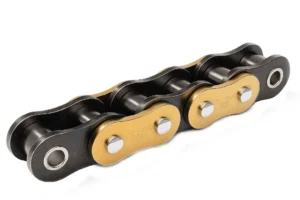
Titan® Harsh Environment Chain features specially coated, low-friction pins and ring-coined connecting links to improve wear life in abrasive applications. Sizes 80–140 also feature patented PerforMax™ solid lube groove bushings. |
 |
Wet or corrosive conditions |
Corrosion can damage surfaces, increase friction, and contribute to premature wear. |
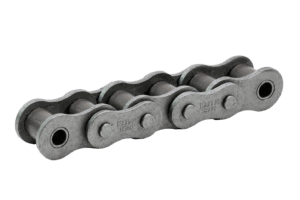
Neptune® Corrosion Resistant Chain features an exclusive surface treatment that provides greater corrosion resistance than nickel-plated chain while maintaining the same maximum allowable load as Tsubaki’s standard carbon-steel roller chain. |
 |
Hard to service areas |
Insufficient lubrication can accelerate wear at the chain joints. |
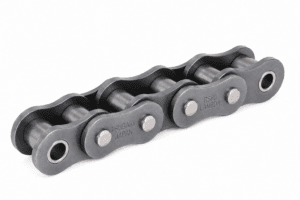
Lambda® Lube-Free Chain features oil-impregnated bushings that continuously lubricate internal bearing surfaces, reducing maintenance while extending chain life. |
 |
The important consideration is not simply whether a chain is considered “premium.” It is whether its design addresses the conditions that are limiting service life.
When Does a Higher-Priced Chain Make Sense?
A higher purchase price does not automatically mean a lower operating cost.
If two chains provide similar service life in a particular application, paying for features the application doesn’t need may provide little additional value.
The calculation changes when a chain’s design addresses a known source of wear or maintenance.
Consider a chain that costs less initially but requires replacement twice as often. Each additional replacement may also involve maintenance labor, downtime, sprocket wear, lubrication, and other costs. Once those factors are included, the initial purchase price may become less significant.
On the other hand, if a drive is easy to maintain, downtime has little consequence, and a general-purpose chain provides acceptable service life, the lower-cost chain may be the appropriate choice. There isn’t one correct answer for every application.
Look at Cost Per Operating Hour
Rather than comparing purchase price alone, maintenance and reliability teams can evaluate chain options based on expected cost per operating hour.
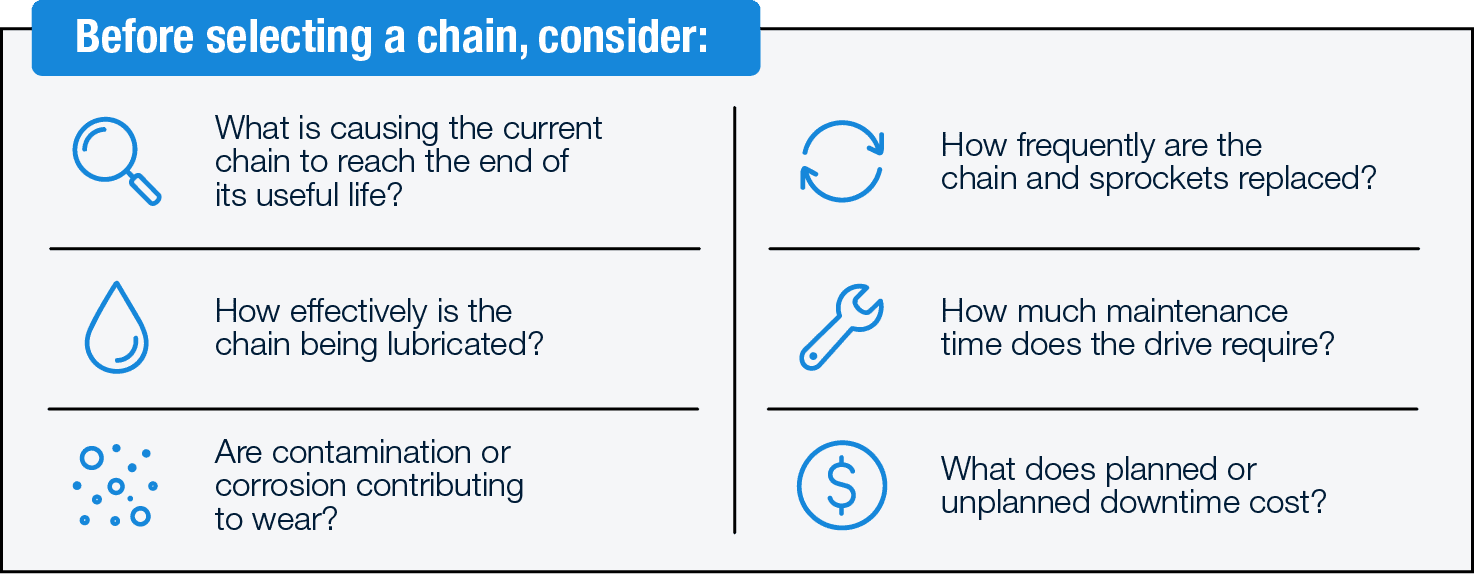
These questions help put the purchase price into context. In some applications, the answers may support a general-purpose roller chain. In others, they may justify greater wear resistance, corrosion protection, or specialized lubrication features.
Ultimately, chain selection should follow the application rather than the price category. Understanding the operating conditions and the primary causes of wear provides a stronger basis for evaluating life-cycle cost—and for selecting a chain that delivers the required performance without paying for features the application doesn’t need.
Comments are closed